|
Take the right STEP for your child - Call today for more information or to register for classes! (413) 734-4458 Nurturing the Family through Music, Creating Music through Mastery You are invited to join the STEP students for the the 21st annual Suzuki String Serenade on Sunday, May 23rd at 3:30 PM at Faith United Church. Admission is free and open to the public. Students aged 5 to adult will be performing folk songs, a foot-stomping Western swing piece called Jesusito Polka, along with classical pieces by Bach, Brahms, Dvorak, Handel, Paganini, von Weber and an arrangement of the ever-popular Overture 1812 by Tchaikowsky. You will be impressed with the quality of even the youngest players, who are trained to produce warm, vibrant tone and play well in tune.
Join us for this exciting finish to a great year of learning together which includes a reception after the concert.
STEP Wednesday Suzuki group classes at Faith United Church are open for observation; call for levels and times.
In the Suzuki world, children and parents learn together in a unique, family-centered approach to music education.
Contact Lani for more information on the next beginning class.
|
| |
|
|
|
 |

 |
 |
 |
 |
|
 |
 |
| |
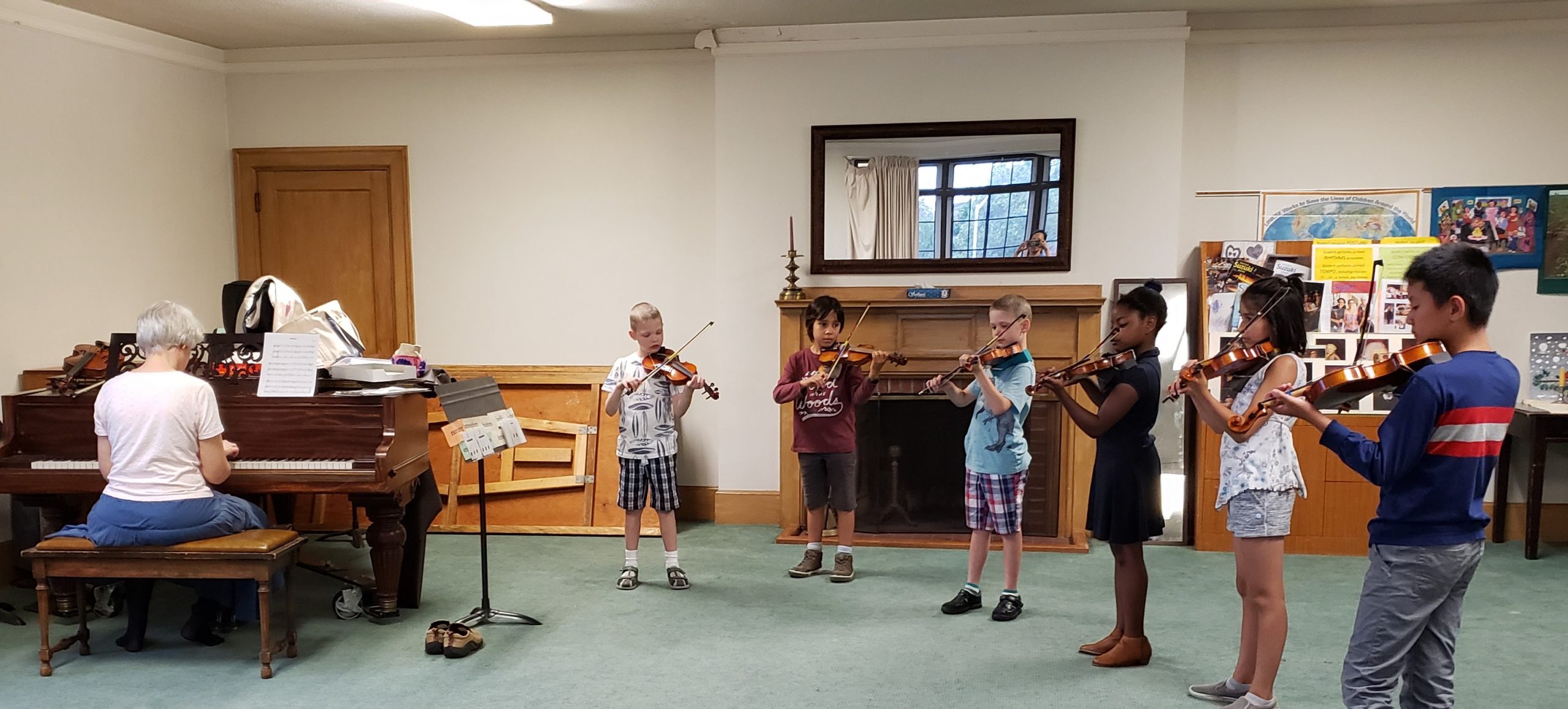
The Suzuki Talent Education Partnership (STEP) was founded in September 2002 by Lani Bortfeld, with the help of students, parents and the community of Springfield, and is now an outreach program of Faith United Church, 52 Sumner Ave. in Springfield, Mass. The students, pictured above with Director Lani Bortfeld leading them, comprise the STEP Suzuki Strings, STEP's multigenerational performance ensemble which rehearses Wednesday evenings at Faith United and gives three formal concerts a year in addition to more informal play-ins and outreach performances. STEP is dedicated to using the principles and teachings of renowned Japanese music educator and humanitarian Dr. Shinichi Suzuki as a basis for its mission of education and outreach to Greater Springfield. Dr. Suzuki believed that every child who could learn to speak could learn to play violin. It is STEP's vision that students of diverse ages, backgrounds and cultures will thrive by experiencing the joy of making music together using Dr. Suzuki's teachings. Through the generosity of the Springfield Suzuki Partnership (the SSP is the STEP family organization), Faith United Church and St. Andrew's Episcopal Church in Longmeadow, STEP is able to give out need-based financial aid to make this vision a reality. To read Ms. Bortfeld's recent article in the Springfield Republican, please go to: http://blog.masslive.com/nie/2008/05/an_approach_that_makes_a_music.html#more
|
Every Child Can
We share Dr. Suzuki's belief that every child who can learn to speak has the ability to learn many other things: math, reading, chess, violin... Dr. Suzuki inspired us by showing how highly developed our children's talent can become if the teacher and family work together using step-by-step learning to help the child achieve mastery. He called this "talent education." Suzuki Talent Education Partnership teachers and parents are members of the Suzuki Association of the Americas (SAA), an association of parents, teachers, and supporters that stretches from South America up to Canada. We will teach an adult in your family, which we call the Home Teacher, to work with your child every day to learn and master the steps of his or her chosen instrument.
We use Dr. Suzuki's Mother Tongue method, wherein the student's musical ear is developed first before learning to read music, much the same way we learn our native language. |
|
The STEP Program
1. Students are expected to practice with the Home Teacher 6 or 7 days a week. "Only practice on the days that you eat," says Dr. Suzuki. 2. The Home Teacher - the family member who is going to practice daily with the child - attends four to six sessions of Home Teacher Training before the child starts on the instrument. This includes 4 sessions with other parents and two lessons learning the basics of your child’s instrument for children aged 8 and younger. 3. Just as we listen daily to learn our native language, so we listen daily to the Suzuki recordings in order to learn the music by ear before we ever play it. 4. The Home teacher attends weekly lessons and biweekly Suzuki group classes with the child. We don't learn to speak just by talking to one person; in the same way, the group classes are a vital part of the Suzuki education. We use games and interactive activities to learn how to make music together. We like to have fun learning! 5. We celebrate our learning through concerts, where family and friends can applaud our achievements. Students perform in a minimum of three concerts a year. 6. We ask families to think in terms of a two-year commitment to the program. Your child probably did not speak in perfect sentences after one year; in the same way, it takes at least two years to reveal the true progress your child is capable of on an instrument.
"Talent = Ability + 10,000 times" - Dr. Suzuki
|
|
All STEP students also become proficient music readers. In this way, STEP students learn to perform in an ensemble using three- and four-part harmony, enjoying the ability to read and perform a variety of music, as well as performing polished solos beautifully from memory. STEP's students are assisted by the newest teaching technologies, including a subscription to Make Music's Smartmusic® intelligent accompaniment and assessment system, and webcam recordings which are emailed to students' homes. STEP concerts include, in addition to the core Suzuki® repertoire, a variety of multicultural and classical music. Recent STEP concerts have included arrangements for strings and percussion such as Mancini's Baby Elephant Walk and Gershwin's Summertime, along with Ms. Bortfeld's arrangements of Old Joe Clark, God Bless America, La Bamba, and My Heart Will Go On for string orchestra.
"Where love is deep, much will be accomplished." – Dr. Shinichi Suzuki About Dr. Suzuki (1898-1998): Dr. Suzuki believed that every child that could learn to speak could learn to play violin. Dr. Suzuki dedicated his life to making instrumental study easier for children, and encouraged families to support their children in all educational efforts. He did not believe that talent was just given at birth, but that each family is responsible for developing and educating the individual child's talent through a nurturing environment that supports learning and appreciating the highest examples of art, music and literature. At the age of 47 and amidst the devastation of post-World War II Japan, he started a music school in Matsumoto dedicated to his philosophy of Talent Education. For more information about Dr. Suzuki, we recommend reading his books Nurtured by Love and Ability Development from Age Zero, and visiting the SAA website at:
|
About Lani Bortfeld, STEP Director: Lani Bortfeld received her B.Mus. from the New England Conservatory of Music and her M.Mus. from the University of Connecticut. Ms. Bortfeld has been trained by the Suzuki Association of the Americas and has been a member of the SAA for 27 years. She is an active performer with her quartet, Arcos/iris, the Waterbury (CT) Symphony Orchestra, and as a freelance musician throughout the region. Ms. Bortfeld received an Artist Fellowship from the Springfield Cultural Council in 1999 to arrange multicultural folk songs, blues and Latin music for her students and continues to arrange classical and ethnic music for the STEP string ensemble. She has also presented at the Suzuki Association of the Americas' biennial conferences in 1994, 1996 and 2008. Her 2008 presentation was entitled "Building Diversity in Suzuki Programs," and reflects Lani's commitment to diversity and equal access. Lani is a registered teacher with the Music Link Foundation, which provides financial aid and services to low-income families who want to give their children music lessons. She is an artist teacher on the Creative Teaching Partners roster of the Massachusetts Cultural Council, and performs in schools, libraries, arts festivals and care facilities. Contact her with any questions about the STEP program at:
|
|
|
 |
|
 |
|
|